

alternative health tips, interesting news and general advice
Wednesday, October 19, 2011
LM92 thermometer in Android (App Inventor)
In this article, we will see how to control temperatures remotely via a Bluetooth link and how to receive events from remote activation of two buttons on our phone with Android. The versatility give us the integrated sensors such as LM92, combined with the practicality of any environment with a mobile device Android, lead us to devise items that previously relied on to carry a laptop wherever necessary to control and / or register events or conditions of work of a machine, an environment or any environment "that must be controlled." Today, thanks to Android, App Inventor to an elementary hardware and built around a 18F25K20 can control all this and more from the comfort of your mobile device.
 In previous articles we could see everything necessary to achieve a link between your mobile device, equipped with Android, and a simple circuit based on a PIC, the powerful 18F25K20 that, thanks to the use of free software Amicus allowed us to receive instructions and data sent from your mobile device. The application, however simple it was, allowed us to achieve a "Hello World" LED lighting a distance. Of course that kicked off the excitement created us to try the backward, ie, transmitting to the device with Android, data generated in our test circuit. Addition of two buttons, we have included in this work a temperature sensor to receive additional data that distance adds more complexity to work, but it serves to imagine that we can exercise total control over a remote computer. That is, we show the potential of comfort that we can achieve, let alone laptops that were once the kings of the field work. Today, Android comes to occupy that place and that everything is easier, faster and convenient than before. Applications can now be developed in unusual areas.
What you see in picture is the application that we have been developing for some items behind, with the benefit of receiving information in the mobile device from our circuit with microcontroller. Remember that you can use any microcontroller and any programming language, for convenience we use the PIC 18F25K20, but these examples can be transferred to any microcontroller. In this particular development, we read with two keys and the data string that sends the integrated thermometer LM92 to be presented on the screen of your mobile device. So far, our work is built on the App Inventor events press a button and it will continue with actions that were presented on the screen of mobile and data sent via Bluetooth to our remote development. These events occurred at a time in which "we decided to perform the action" and the pic looked HSERIN instruction to receive the data, interpret and execute the work according to the structure of the data sent. Now, it is our Android phone that should be listening and attentive, permanently, waiting for instructions or data that the PIC can send at any time HSEROUT command. It is very important to understand this: field application can send data at any time and Android should be alert always.
In previous articles we could see everything necessary to achieve a link between your mobile device, equipped with Android, and a simple circuit based on a PIC, the powerful 18F25K20 that, thanks to the use of free software Amicus allowed us to receive instructions and data sent from your mobile device. The application, however simple it was, allowed us to achieve a "Hello World" LED lighting a distance. Of course that kicked off the excitement created us to try the backward, ie, transmitting to the device with Android, data generated in our test circuit. Addition of two buttons, we have included in this work a temperature sensor to receive additional data that distance adds more complexity to work, but it serves to imagine that we can exercise total control over a remote computer. That is, we show the potential of comfort that we can achieve, let alone laptops that were once the kings of the field work. Today, Android comes to occupy that place and that everything is easier, faster and convenient than before. Applications can now be developed in unusual areas.
What you see in picture is the application that we have been developing for some items behind, with the benefit of receiving information in the mobile device from our circuit with microcontroller. Remember that you can use any microcontroller and any programming language, for convenience we use the PIC 18F25K20, but these examples can be transferred to any microcontroller. In this particular development, we read with two keys and the data string that sends the integrated thermometer LM92 to be presented on the screen of your mobile device. So far, our work is built on the App Inventor events press a button and it will continue with actions that were presented on the screen of mobile and data sent via Bluetooth to our remote development. These events occurred at a time in which "we decided to perform the action" and the pic looked HSERIN instruction to receive the data, interpret and execute the work according to the structure of the data sent. Now, it is our Android phone that should be listening and attentive, permanently, waiting for instructions or data that the PIC can send at any time HSEROUT command. It is very important to understand this: field application can send data at any time and Android should be alert always.


Friday, September 23, 2011
Warca: Shoot a camera, not a gun (video)
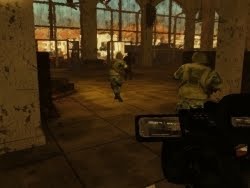
WARC is an FPS game set in the war in the Middle East and North Africa. So far nothing unusual. The interesting thing is that they interpret a single soldier in combat, but a journalist only be equipped with a camera. A FPS where you do not shoot any firearm? Better yet, just keep reading.
 Today it is common to find games based on war FPS like Call of Duty or Battlefield, where the command of a soldier to fulfill different objectives throughout the game pitted against other soldiers and terrorists. What is not normal is that in a game of this style controls to a reporter instead of firing a gun, put shooting. And this is what gives us WARC, which tells the story of Jesse DeMarco, a journalist who must take photos in the conflict that will travel throughout the game.
The idea of the game is that players achieve real-world experience of war journalism through the process of filming the conflict to enter into different risk situations equipped with a camera. As we move forward, the scenarios will from action packed to quieter moments where we talk with our colleagues on developments.
The game has the support of the Australian journalist and filmmaker Tony Maniaty Robert Connolly, who directed the film Balibo, a political thriller about the deaths of Australian journalists during a conflict in East Timor in 1975.
Graphically the game can see that developing still lacking polish some specifics, such as the effects of fire and light. Being developed for four months and Defiant Development Brisbane, WARC is currently in the process of letting us find a distributor in doubt about your departure date and for which platform will be available. What do you think of the idea?
Today it is common to find games based on war FPS like Call of Duty or Battlefield, where the command of a soldier to fulfill different objectives throughout the game pitted against other soldiers and terrorists. What is not normal is that in a game of this style controls to a reporter instead of firing a gun, put shooting. And this is what gives us WARC, which tells the story of Jesse DeMarco, a journalist who must take photos in the conflict that will travel throughout the game.
The idea of the game is that players achieve real-world experience of war journalism through the process of filming the conflict to enter into different risk situations equipped with a camera. As we move forward, the scenarios will from action packed to quieter moments where we talk with our colleagues on developments.
The game has the support of the Australian journalist and filmmaker Tony Maniaty Robert Connolly, who directed the film Balibo, a political thriller about the deaths of Australian journalists during a conflict in East Timor in 1975.
Graphically the game can see that developing still lacking polish some specifics, such as the effects of fire and light. Being developed for four months and Defiant Development Brisbane, WARC is currently in the process of letting us find a distributor in doubt about your departure date and for which platform will be available. What do you think of the idea?
Thursday, September 22, 2011
Bonsai solar to recharge mobile devices

"The inspiration for design came to me while watching Electree trees. The leaves of the trees are real natural solar panels," explains Muller. "Therefore, the shape of the tree is the best way to harness solar energy." That was the reason that the charger looks like a small bonsai composed of 27 small solar panels that double-leaf. Mounted on supports (the "branches" of the tree), each panel can rotate freely, which allows the user to create an unlimited number of ways. "I wanted Electree is a product to be used inside, so that the aspect of bonsai that I thought was best," says the French designer.
The first 400 units sold will be numbered.
The Electree is about 40 inches high and provides a few hundred mAh if all its panels are directly illuminated by the Sun, which is quite difficult to get inside a home or office. The energy is stored in a battery that has at its base and sent to devices charged via a USB connector. Some of your gadgets require an adapter to be connected to this source of energy. Anyway, you still can not go to the store and take one home, they have not begun to be produced. The designer has enabled the option to make a "pre-purchase" online (paying 299 euros, by the way) and when production begins thousand orders. The first 400 units sold will be numbered and accompanied by a certificate signed by Vivien Muller, with shipping charges on account of the manufacturer.
While this is a pretty useful product and does not seem to be strictly "original". Not long ago we saw a young student as more than shocked to discover that a scientist if you have solar panels in the same way that the leaves of trees can significantly increase the production of electricity. Muller solar charger seems to be simply a nice implementation of this principle, but with the disadvantage of being thought of as an ornament for indoors, a site that usually sunlight often reach only a few hours . Despite these drawbacks, you may find 1000 interested in paying $299 for a home Electree. Are you aiming with one?
Source: http://www.electree.fr/vivien.muller/Electree-en.html
Wednesday, September 21, 2011
Today, is World Alzheimer's Day 2011

In addition, the progressive aging of the population will increase in coming decades in a very considerable number of people over 65 years. It is estimated that about 30-40 even years to double the current figure, which would be more than a million and half people affected by the disease in Spain.
BUT WHAT IS ALZHEIMER?
We have spoken on countless occasions of what is and what causes this disease, but such an important day, not get tired of tell thee. Alzheimer's is a degenerative process probably produced by the deposition of amyloid beta protein and generates a gradual loss of neurons and their connections. Except in the rare cases where the disease is caused by a genetic mutation, Alzheimer's disease has no known cause. For distribution to the brain causes cognitive symptoms, behavioral symptoms and ultimately loss of functional capacity and limit the autonomy and independence.
As you know, the risk factors of this disease are many: population, advanced age, gender (female), illiteracy and medical history, especially those known as cardiovascular risk factors (diabetes, smoking, hypertension, high cholesterol and other depression, menopause, etc.).
Some of the most common symptoms of this disease: progressive memory loss, inattention, difficulty performing familiar tasks, problems with language, disorientation in time and space, difficulty in recognizing objects and people, and so on.
TREATMENT AND RESEARCH
Alzheimer's disease is treatable, but has not yet found a cure. There are four drugs that have shown efficacy in improving cognitive-behavioral symptoms and functional. These are drugs that can 'stabilize' one to two years the evolution of symptoms and may even delay the need for admission to residence. Dr. Pablo Martínez-Lage Alvarez, coordinator of the behavior and dementia of the Spanish Society of Neurology new window, gives us his opinion on how important it is time to catch the disease:
"Early diagnosis becomes a fundamental tool for improving quality of life of patients. The problem is that often the initial stage may be overlooked. As the disease has a varied form of appearance does not follow a unique pattern and has a gradual development, it is sometimes difficult for the patient or his family to distinguish the early symptoms of Alzheimer changes of old age. "
"It's important to know that age by itself does not cause dementia. The age may decrease the speed at the time to learn or remember when, but does not explain the loss of memory, does not justify the everyday memory failure, repeated and persistent. When someone asked if a loved one, whether he or she is starting with an Alzheimer's that it's time to go to the doctor and that is the time when the physician must be prepared to give a professional response based on clinical evaluation and a proportionate and appropriate diagnostic studies as well as full respect for rights and autonomy of the person consulting. "
The doctor continues:
"Although in recent years there have been significant advances in our understanding of disease, as well as early diagnosis is necessary to continue to promote efforts to promote health education of the population about what the early symptoms and promote effective coordination between health primary and specialist to ensure the best response to the demand for diagnostic of the person who complains about memory leaks. The diagnostic and therapeutic clinical research remains crucial to one of the diseases that increase in incidence in the coming years. "
"In particular, in Spain, clinical research has been showing for years a significant delay compared to other developed countries. Is necessary to enhance the clinical units of dementia, brain banks, clinicopathologic studies, projects anatomical and functional neuroimaging and clinical centers that support research. "
Source and credits: cuidadoalzheimer.com
You are what you think

The thoughts make the man. As a man thinketh so is he.
If man thinks that all people are good (I always find good people and respectful in my way), then good people will be on your walk. If you think that the world is full of opportunities, you'll find, if you think I am love, prosperity and abundance, it will.
We human beings have a great power inside us that rarely appreciate, because we see our mind ... are what we think.
All we are we are in our thoughts. And with our thoughts, we build our world.
- Buddha
You create your life with your thoughts. Or, more specifically, your deepest beliefs that live in your subconscious. If you think health, love, money, prosperity, wealth, continually, continuously, and if you think you focus your mind on achieving your subconscious print these positive thoughts in every moment of your life, that's what you will receive shortly.
Life, the universe is created in thought.
Woe to them that devise iniquity, and those who make evil on their beds! When the morning is light they practice it, because they have the power in his hand.
- Mic 2:1
Good for those who think bedtime beautiful things in the visions of grandeur.
"O king, the thoughts that stirred in the bed your mind related to what will happen in the future, and who reveals mysteries made known to you what will happen.
Daniel 2:29
"The life of a man is what his thoughts want to be."
- Marco Aurelio
The universe is created with ideas, information. All the universe you perceive as the material universe is due to mental universe that you accept as real.
The mental set is the set of ideas, thoughts, beliefs, scruples, values, etc.. you accept. Your mind creates your world together. If you want to change your world, your life, you change your mind set.
The mental set are the parameters that you accept as true.
For your current personality, which began to form your mind set from the moment you were conceived / a.
From the time you were getting ideas, truths, values, be used to create this world.
We see only what we know.
Johann Wolfgang von Goethe (1749-1832) German writer and thinker
The comet Elenin will not destroy Earth

It approaches Earth at nearly 90,000 km. per hour and its closest approach to Earth will occur on 16 October. According to some, however, several weeks before that day the comet Elenin (officially designated C/2010 X1) planted in our world a wave of death and destruction as has not been known until now. Massive eruptions, major earthquakes, tsunamis, catastrophic solar flares, magnetic reversal of the poles and a whole string of disasters with an intensity never before seen by man. It will be between 26 and 27 this September. The reason for so much destruction, according to those who feed the idea is that, precisely during those days, the comet will be aligned with the Earth and the Sun Which, to understand, means that you could draw a straight line to play at a time the three celestial bodies. And it's the last two times I saw that lineup coincided with earthquakes of Chile (February 27, 2010) and Japan (March 11, 2011). Some "scientists" (including a certain Mensur Omerbashib) curl curl and strive to complete the list of astronomical alignments disastrous. And they have found all of them, when they occur, consistent with earthquakes of magnitude greater than 6. Omerbashib argues that, despite its small size (compared to a planet), the destructive potential of comets (and other celestial objects) when they are aligned with other worlds is due to "a phenomenon of resonance magnification" he himself has described and which has come to present to experts at Cornell University.
Without much success, indeed. To complete the picture, others have wanted to see this comet Niburu, the obscure and unknown "Planet X" Solar System, a mysterious world that just happens around us each many thousands of years, inexorably causing major disasters and mass extinctions. Or say that even this could be a companion star called the Sun (a small brown dwarf) star does not shine (and that has not been discovered) but its enormous mass, several times that of Jupiter, become a real harbinger of destruction. It all started a few months ago, when an Internet user, playing with an educational program at the Jet Propulsion Laboratory, NASA, which allows you to draw a diagram of the orbits of the planets known objects, noticed that precisely in the days when Elenin position aligned with the Earth and the Sun there were two earthquakes in Chile and Japan. During the first alignment (the February 27, 2010) the Elenin was about 630 million km. of the Earth. During the second (March 11 this year), was reduced to half that distance (about 300 million km), which would explain that the earthquake in Japan was much more destructive than that of Chile. What will be able to do during the next Elenin alignment, the 26 to 27 this month, when only be about 50 million miles away? With these premises, and as has happened on other occasions, the story spread like wildfire through the Internet and social networking. And a cloud of "experts" have been added to the virtual forums with new data and "scientific calculations" that demonstrate the inevitability of the catastrophe.
As the weeks pass and the d "day" approaches, the stories multiply and blend into each other: NASA knows what will happen and hides, several astronomers who wanted to reveal the truth have died in a within a few days victims of a rare disease, the comet is only the vanguard of an alien invasion that is hidden in its wake ... There is something for all tastes. In this situation, NASA in mid-August issued a statement calling for calm and explaining that none of this will happen. The comet is only 3.5 km. diameter is too small to alter the orbit of a planet or to remove the Earth's tectonic plates and cause earthquakes. In addition, during its closest approach to the Elenin will be more than 35 million km. away, 92 times what separates us from the moon and almost the same as that between the Earth and Venus. Not to mention that Elenin reached on September 10th point of closest approach to the Sun (perihelion) and scientists have found in recent days, a rapid decline in brightness, which suggests that, consumed by solar radiation, is a disintegrating comet. As it is, almost certainly, his last trip around the Sun. The images in these lines show how he saw the comet on 29 August and how, after its perihelion, no trace of him could be seen on 14 September.
Praise your children for their effort, not intelligence
Carol Dweck, a psychologist at Stanford, has devoted years to prove that one of the key elements of successful education is the ability to learn from mistakes. However, we often teach the opposite. If a child makes mistakes, is not very smart. The set does not make mistakes, and also precisely why we praise him for being ready. Few people are praising others for their effort, not innate ability.
 Dweck conducted an experiment with more than 400 children from twelve schools in New York, were subjected to a very easy test consisting of a non-verbal puzzle. Once completed, the experimenter said the note to the child, followed by a phrase of praise. Half of the children were praised for their intelligence, the other half, for their efforts.
Then they were allowed to choose between two different tests. The first option is described as a series of difficult puzzles, but told the children that if they tried, they would learn a lot. The other option was a simple test, similar to what they had done.
When designing the experiment, Dweck had imagined that the different forms of praise would have a rather moderate. At the end of the day, it was just a phrase.
Dweck conducted an experiment with more than 400 children from twelve schools in New York, were subjected to a very easy test consisting of a non-verbal puzzle. Once completed, the experimenter said the note to the child, followed by a phrase of praise. Half of the children were praised for their intelligence, the other half, for their efforts.
Then they were allowed to choose between two different tests. The first option is described as a series of difficult puzzles, but told the children that if they tried, they would learn a lot. The other option was a simple test, similar to what they had done.
When designing the experiment, Dweck had imagined that the different forms of praise would have a rather moderate. At the end of the day, it was just a phrase.
However, it soon became clear that the kind of compliment that became the fifth graders dramatically influenced subsequent choice tests. The group of children congratulated for their effort, 99% chose the set of difficult puzzles. For their part, most of the kids praised for their intelligence, they decided on the easier test. When we praise the intelligence of a child, we are actually getting the message: be smart, do not risk making mistakes. Dweck The following experiments also suggest that this fear of failure also inhibits learning. With the same group of group of children were subjected to another test, this time very difficult to see how they responded to the challenge.
Those who had been praised for their effort in the first trial, worked assiduously to solve the problem, engaging with great enthusiasm. However, children praised for their intelligence is quickly discouraged because they considered the inevitable mistakes as signs of failure, perhaps, deep down, they thought, were not ready. The final series of tests showed the same level of difficulty than the first. In any case, students praised for effort showed significant improvement: their average score increased by 30%. As these children were willing to accept challenges (although at first it meant missing), ended up paying a much higher level. This result was even more admirable when comparing with students who had been randomized to the group "ready" scores dropped an average of almost 20%. For children "ready", the experience of failure had been so daunting that actually experienced a setback.

However, it soon became clear that the kind of compliment that became the fifth graders dramatically influenced subsequent choice tests. The group of children congratulated for their effort, 99% chose the set of difficult puzzles. For their part, most of the kids praised for their intelligence, they decided on the easier test. When we praise the intelligence of a child, we are actually getting the message: be smart, do not risk making mistakes. Dweck The following experiments also suggest that this fear of failure also inhibits learning. With the same group of group of children were subjected to another test, this time very difficult to see how they responded to the challenge.
Those who had been praised for their effort in the first trial, worked assiduously to solve the problem, engaging with great enthusiasm. However, children praised for their intelligence is quickly discouraged because they considered the inevitable mistakes as signs of failure, perhaps, deep down, they thought, were not ready. The final series of tests showed the same level of difficulty than the first. In any case, students praised for effort showed significant improvement: their average score increased by 30%. As these children were willing to accept challenges (although at first it meant missing), ended up paying a much higher level. This result was even more admirable when comparing with students who had been randomized to the group "ready" scores dropped an average of almost 20%. For children "ready", the experience of failure had been so daunting that actually experienced a setback.
Subscribe to:
Posts (Atom)